
Non-Lucrative vs Digital Nomad Visa: Which One for Your Family?
Last updated: 19 June 2026 · by Khris Rueda, Founder of Spainlander
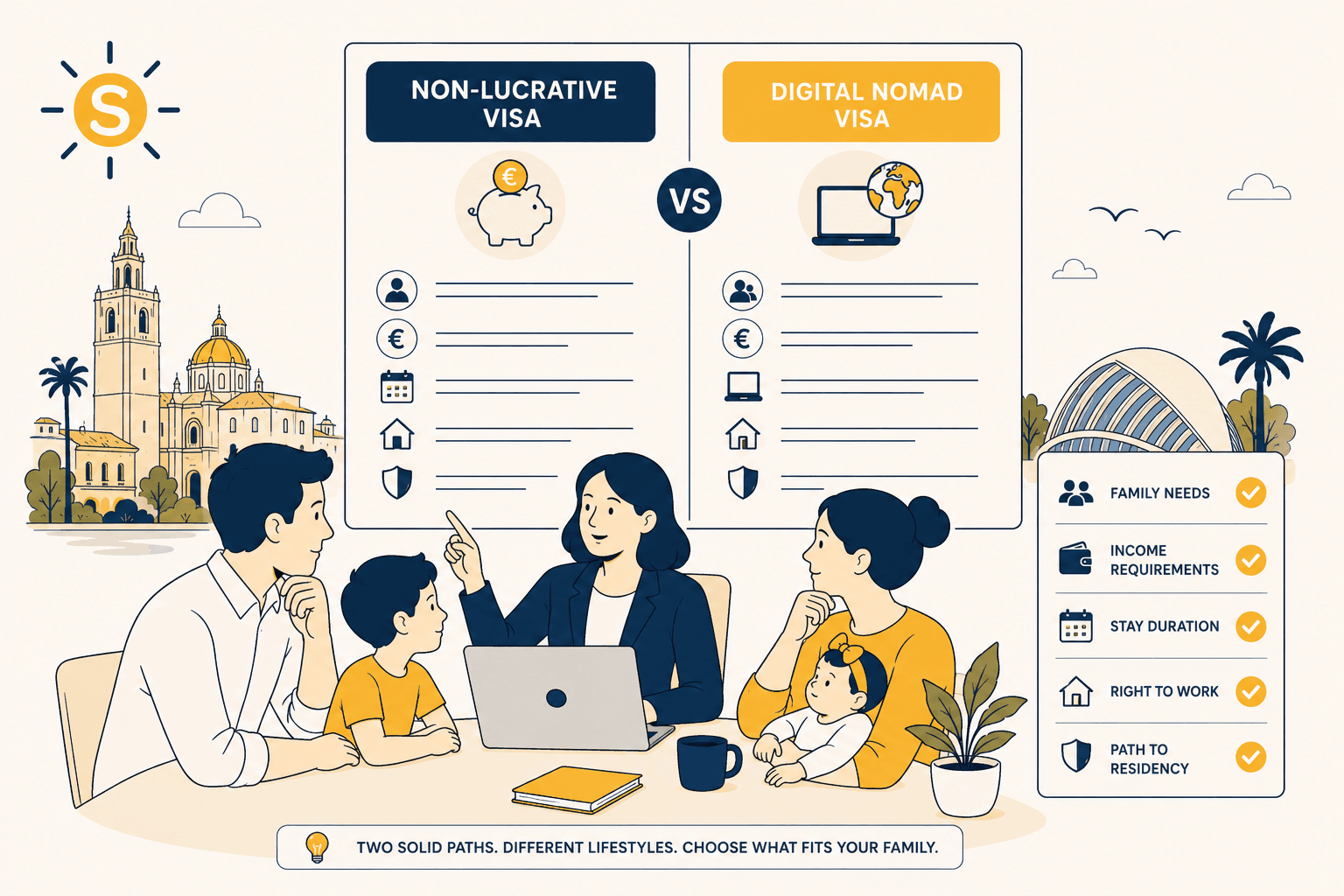
If you work remotely, you want the Digital Nomad Visa. If you will live on passive income such as a pension, rental income, dividends, or savings, you want the Non-Lucrative Visa. That single distinction, whether you will keep earning from work while in Spain, decides the...
Key takeaways
- Digital Nomad Visa (DNV): for families where a parent keeps a remote job or freelance clients based outside Spain. Working is the whole point of it.
- Non-Lucrative Visa (NLV): for families who will not work in Spain and can show enough passive income or savings to support themselves.
- 2026 income, DNV: roughly EUR 2,500 to EUR 2,800 per month for the main applicant (around 200% of the Spanish minimum wage), plus an uplift for each family member.
- 2026 income, NLV: roughly EUR 2,400 per month for the main applicant (400% of the IPREM index), plus roughly EUR 600 per month for each additional family member.
- Both let you bring your spouse and children on one application, and both lead to permanent residency after five years.
Before you set a date
Is your landing date realistic?
Most families move to Valencia three months later than they planned, because they find out about the school calendar too late. Five questions, thirty seconds, and you will know whether your date works.
Run the Readiness CheckIf you work remotely, you want the Digital Nomad Visa. If you will live on passive income such as a pension, rental income, dividends, or savings, you want the Non-Lucrative Visa. That single distinction, whether you will keep earning from work while in Spain, decides the route for almost every family. Everything else is detail, and we walk through it below.
The short version
- Digital Nomad Visa (DNV): for families where a parent keeps a remote job or freelance clients based outside Spain. Working is the whole point of it, as described in Spain's official telework visa guidance.
- Non-Lucrative Visa (NLV): for families who will not carry out gainful activity in Spain and can show enough passive income or savings to support themselves, as described in the official non-working residence visa guidance.
- 2026 income, DNV: roughly EUR 2,500 to EUR 2,800 per month for the main applicant, based on the consular guidance that ties the threshold to 200% of Spain's minimum wage, plus an uplift for each family member.
- 2026 income, NLV: roughly EUR 2,400 per month for the main applicant, based on 400% of the IPREM index, plus roughly EUR 600 per month for each additional family member.
- Both let you bring your spouse and children on one application, and both can support a longer stay if you keep renewing and meet the conditions.
These figures reset each January, so confirm the current numbers with your consulate or adviser before you apply.
What each visa is actually for
The Non-Lucrative Visa is the older, simpler route. It says, in effect, "we will support ourselves without taking work in Spain." It suits retirees, financially independent families, and anyone planning a sabbatical year. The trade-off is in the name: it is non-lucrative, so you cannot work, not for a Spanish employer and not remotely for a foreign one.
The Digital Nomad Visa was built for exactly the situation that used to sit in a legal grey zone: a parent with a laptop and an employer or clients abroad, wanting to live in Spain legally while keeping that income. Spain's consular guidance makes that route explicit.
For most families the choice writes itself. If income stops the day you land in Valencia, you are looking at the NLV. If income continues because the work continues, you are looking at the DNV.
The money: income and savings compared
Both visas ask you to prove you can support your family. They simply count different kinds of money.
| Non-Lucrative Visa | Digital Nomad Visa | |
|---|---|---|
| Type of income | Passive only (pension, rent, dividends, savings) | Active remote work for non-Spanish entities |
| Main applicant, 2026 | Around EUR 2,400 per month (400% IPREM) | Around EUR 2,500 to EUR 2,800 per month (200% SMI) |
| Each family member | Add roughly EUR 600 per month (100% IPREM) | Add roughly 75% of SMI for the first, 25% for each child |
| Can savings substitute? | Yes, a lump sum covering the year is widely accepted | Partly, though steady work income is the core test |
| Spanish-source income | Not applicable, no work permitted | Capped at 20% of total income |
A working couple with two children applying for the DNV should plan for a household income comfortably above EUR 3,500 per month from foreign sources. A retired or financially independent family of four on the NLV should plan to show roughly EUR 4,200 per month or a savings lump sum of similar annual size. Treat these as planning figures and verify the exact thresholds at the point of application.
Tax: the part families overlook
Tax treatment is where the two routes genuinely diverge, and it is worth understanding before you choose.
On the NLV, Spanish tax residence is generally triggered once you spend more than 183 days in Spain in a calendar year, according to the IRPF law in the BOE. On the DNV, the special regime for workers displaced to Spain sits in article 93 of the IRPF law and can apply for the year of the move and the following five tax periods if the conditions are met. That is why the DNV can change the tax outcome so much for remote workers. For the rules themselves, see our guide to Valencia for expats.
Time, renewal, and the path to staying
The DNV and NLV both involve document collection, apostilles, sworn translations, background checks, and consulate queues. Allow more runway than you think.
The honest part: do not work remotely on a Non-Lucrative Visa
For years, families quietly worked remotely on an NLV and hoped nobody noticed. That was never legal, and the safer rule now is simple: pick the route that matches how the income is earned.
If you work, apply for the visa built for work. The peace of mind is worth more than the slightly lighter NLV paperwork, and a clean application protects your renewal and your family's status down the line.
What we would do
For a working family, the Digital Nomad Visa is almost always the right call. It legitimises the income that funds your whole move, it opens the Beckham Law option, and it gives you a longer runway than the non-lucrative route. The NLV is the right home for genuinely passive families: retirees, those between careers, or anyone taking a deliberate year out who can prove the means.
The mistake we see most often is families choosing the route that looks easier on paper rather than the one that matches how they actually earn. Match the visa to your real situation, and the rest of the move gets simpler.
Questions
Frequently asked questions
Can my spouse work in Spain on these visas?
On the DNV, a partner included as a dependent can generally apply for work authorisation, though the rules are specific. On the NLV, neither the main applicant nor the spouse may work without a separate permit. We cover this in detail in our guide to whether a spouse can work on your Spanish visa.
Which visa is cheaper to get?
Application cost is usually driven by document preparation, sworn translations, insurance, and any legal help rather than by the visa fee itself.
Can I switch from the Non-Lucrative to the Digital Nomad Visa later?
Choose the right route from the start rather than planning to convert later.
Do both visas let me bring my children?
Yes. Both are family-joint applications. Your spouse and minor children are included, and you prove additional income or savings for each dependent.
Does buying property help with either visa?
Property buying still does not create residency on its own.
Sources
- Spain's official consular guidance states that the non-working visa is for residence without gainful activity and requires sufficient means. Exteriores - Non-working residence visa accessed 2026-06-03
- Spain's official consular guidance states that the telework visa is for remote work outside Spain and sets the income threshold at 200% of the minimum wage. Exteriores - Digital Nomad Visa accessed 2026-06-03
- Article 9 of the IRPF law sets the 183-day tax residency rule. BOE - Ley 35/2006, article 9 accessed 2026-06-03
- Article 93 of the IRPF law sets the special regime for displaced workers to Spain. BOE - Ley 35/2006, article 93 accessed 2026-06-03
Before you set a date
Is your landing date realistic?
Most families move to Valencia three months later than they planned, because they find out about the school calendar too late. Five questions, thirty seconds, and you will know whether your date works.
Run the Readiness CheckSpainlander plans
Spainlander plans Valencia moves for international families, sequenced around the school decision. Founded by Khris Rueda after moving from Canada in 2022. Three plans, each for up to two children:
- The Shortlist, €989
In seven days you know which education route fits your children, which schools are worth an application, and which dates govern your arrival.
See what a Shortlist looks like - The Application, €2,450
Your school decision becomes applications that are prepared properly, submitted with you inside the window, and followed until there is an answer.
- The Landing, €6,900
We take responsibility for coordinating your school, housing, administrative and arrival workflow, so your first weeks run on a sequence instead of on your evenings.
Final price. Taxes included where they apply.