
Spain 183-Day Tax Residency Rule Explained for Valencia Movers
Last updated: 7 September 2026 · by Khris Rueda, Founder of Spainlander
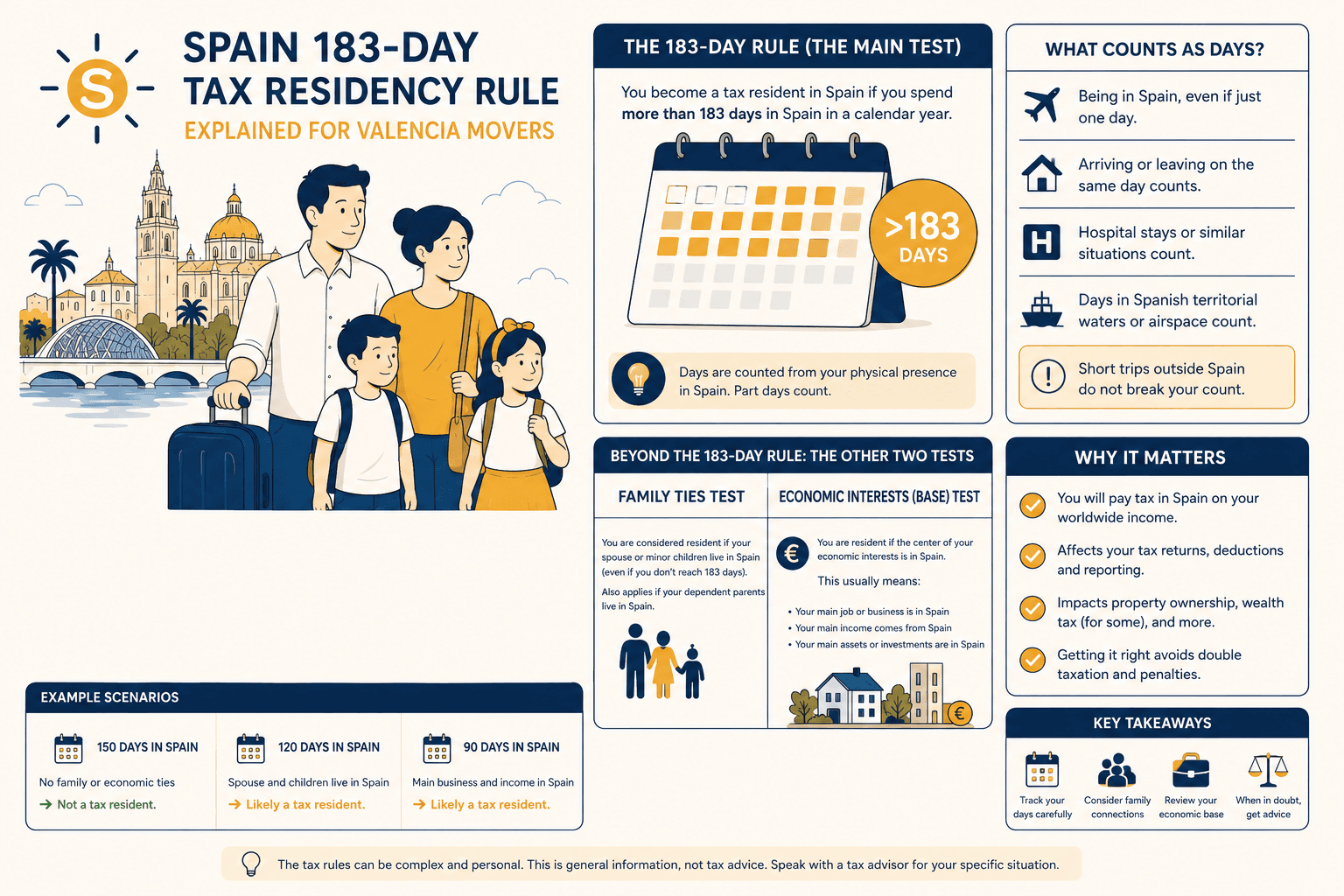
If you stay in Spain for more than 183 days in a calendar year, the Tax Agency generally treats you as tax resident. That is the core rule, but it is not the only thing that matters, because family ties, economic interests, and special regimes can change the practical outcome.
Key takeaways
- More than 183 days usually makes you tax resident.
- Absences can still count unless you prove another residency.
- Family and economic interests also matter.
- The special regime window is time-sensitive.
Before you set a date
Is your landing date realistic?
Most families move to Valencia three months later than they planned, because they find out about the school calendar too late. Five questions, thirty seconds, and you will know whether your date works.
Run the Readiness CheckLast updated: June 2026
If you stay in Spain for more than 183 days in a calendar year, the Tax Agency generally treats you as tax resident. That is the core rule, but it is not the only thing that matters, because family ties, economic interests, and special regimes can change the practical outcome.
What the rule says
The Agencia Tributaria states that a natural person is habitually resident in Spain when they remain in Spain for more than 183 days during the calendar year. Absences can count as days in Spain unless you can prove tax residence in another country. That is why travel logs, contracts, and residency evidence matter.
For most families moving to Valencia, this is the date rule to watch. If your days in Spain cross that threshold in the same year you move, you should assume the Spanish tax system is likely to treat you as resident for that year and plan accordingly.
Why the family test matters
The tax authority also looks at where your family and economic base are. If your spouse and minor children live in Spain, or if your main economic interests are here, the residency analysis can point to Spain even before you get close to the 183-day mark. That is why this is not just a counting exercise.
For families, the practical answer is simple: do not wait until the end of the year to think about tax residency. The move date, the school start date, and the working pattern all shape the result. If you are unsure, use the move planning stage to speak to a tax adviser before you land in Valencia.
Where Beckham Law fits
Spain's special regime for displaced workers can apply to qualifying arrivals, including some remote workers and their families, and the Tax Agency says the option must be exercised within the stated window after arrival or the start of activity. The regime applies for the year of arrival and the five following tax periods, so the timing is not a minor detail.
That is why a family moving to Valencia should align tax planning with immigration planning, not treat them as separate worlds. The right visa, the right arrival date, and the right paperwork sequence can save a lot of friction later.
Practical calendar for arrivals
- Count the days from the moment you start spending real time in Spain.
- Track absences and keep proof of residence in another country if relevant.
- Decide early whether you are likely to become Spanish tax resident in that calendar year.
- If you qualify for a special regime, submit the option in the correct window rather than assuming you can fix it later.
The biggest mistake is assuming the rule only applies to people who buy a house or move full-time from day one. In practice, a slow arrival can still create tax residency if the calendar tips over 183 days.
How this affects Valencia families
If you are moving with children, tax residency is one more reason to line up the move in a careful sequence. The same calendar that drives school admissions and housing also drives tax status. For the family side of the move, see our visa comparison guide and our healthcare guide.
Read next
If the 183 days are the question, the two that follow are which visa route you are on and how your children's school year lines up: Non-Lucrative or Digital Nomad, and the schools guide.
Questions
Frequently asked questions
Does a residence permit make me tax resident?
Not by itself. Tax residency is decided by facts such as days in Spain, family location, and economic interests, not just by immigration paperwork.
Do absences break the 183-day count?
Not automatically. The Tax Agency says absences can count unless you prove tax residence in another country.
Does the 183-day rule apply to children too?
The rule applies to each person individually, but a family living together in Spain usually creates a strong residency picture for the household.
How long does the special regime last if I qualify?
The Tax Agency says the special regime applies for the year of arrival and the five following tax periods.
Should I get tax advice before moving?
Yes. The rule is simple to say and easy to mishandle in practice, especially if you move mid-year or have income from several countries.
Sources
- The Tax Agency says a person is habitually resident in Spain when they remain more than 183 days in the calendar year. Agencia Tributaria - Persona fisica residente en Espana accessed 2026-06-03
- The Tax Agency says absences can count unless tax residence elsewhere is proven. Agencia Tributaria - Persona fisica residente en Espana accessed 2026-06-03
- The Tax Agency says the special regime option must be filed within six months of arrival or activity start in the current guidance. Agencia Tributaria - Exercising the option for the special regime accessed 2026-06-03
- The Tax Agency says the special regime applies for the year of acquisition and the five following tax periods. Agencia Tributaria - Duracion accessed 2026-06-03
Before you set a date
Is your landing date realistic?
Most families move to Valencia three months later than they planned, because they find out about the school calendar too late. Five questions, thirty seconds, and you will know whether your date works.
Run the Readiness CheckSpainlander plans
Spainlander plans Valencia moves for international families, sequenced around the school decision. Founded by Khris Rueda after moving from Canada in 2022. Three plans, each for up to two children:
- The Shortlist, €989
In seven days you know which education route fits your children, which schools are worth an application, and which dates govern your arrival.
See what a Shortlist looks like - The Application, €2,450
Your school decision becomes applications that are prepared properly, submitted with you inside the window, and followed until there is an answer.
- The Landing, €6,900
We take responsibility for coordinating your school, housing, administrative and arrival workflow, so your first weeks run on a sequence instead of on your evenings.
Final price. Taxes included where they apply.