
Best Valencia Neighborhoods for Families
Last updated: 3 September 2026 · by Khris Rueda, Founder of Spainlander
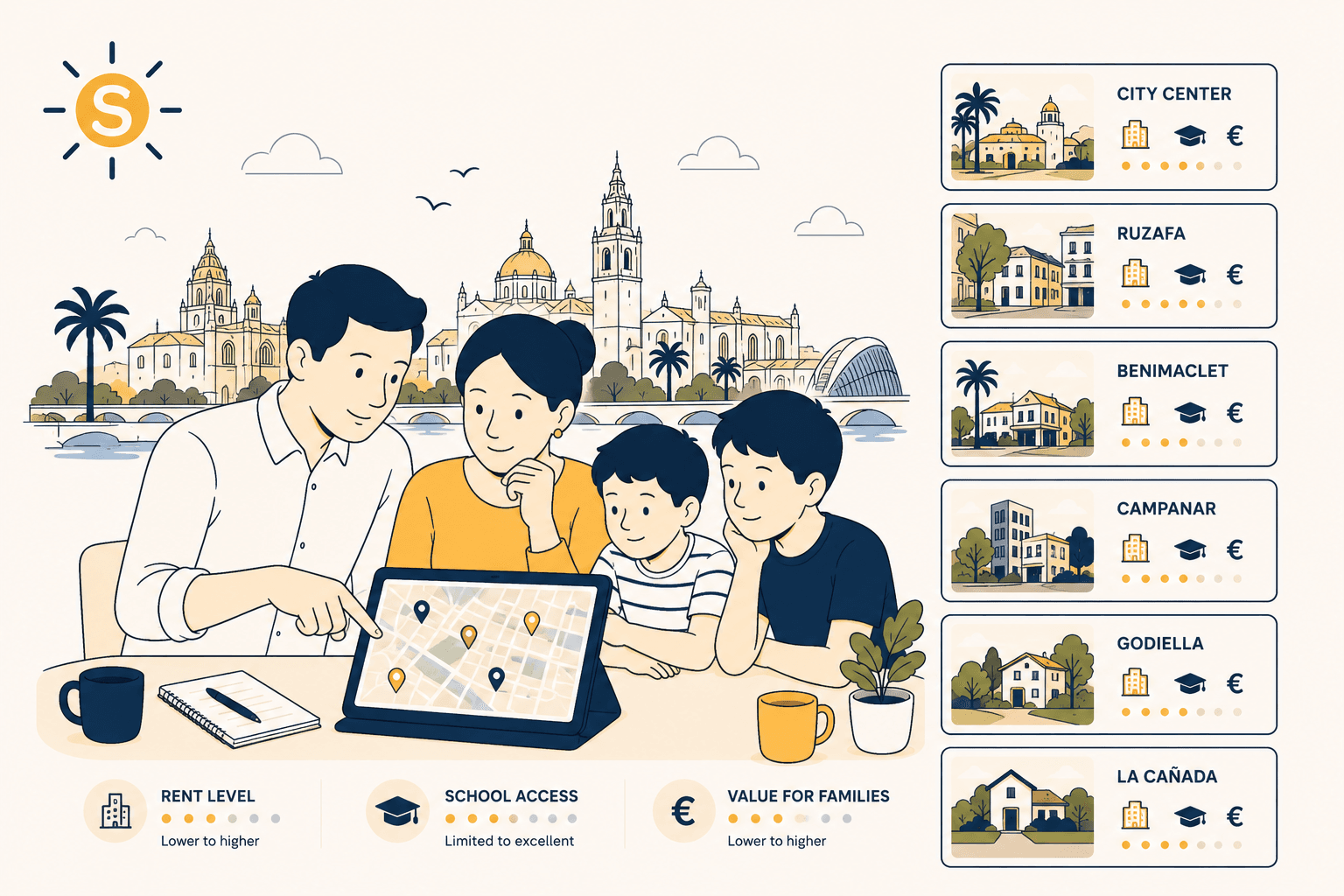
Families relocating to Valencia face a core choice: embrace city energy in walkable neighborhoods like Ruzafa or Pla del Real, or seek suburban space and international schools in areas such as L'Eliana or Godella.
Key takeaways
- Valencia families choosing city life gravitate towards Ruzafa, Eixample, Pla del Real, El Cabanyal, or Campanar for walkability.
- Families seeking suburban space and international schools often settle in L'Eliana, Rocafort, Godella, Bétera, or Puzol.
- City living in Valencia means walking or cycling to school, less reliance on a car, but apartments are common and gardens rare.
- Suburban Valencia offers ample space and gardens, but usually requires a car, placing spontaneous city life a drive away.
- School choice is often the primary deciding factor for families, influencing commutes and shaping social circles in Valencia.
- Family barrios are not the same as the famous nightlife barrios - skip the standard guides.
- Pla del Real is the most consistently family-friendly central choice, against the Turia park.
- Mestalla offers a similar profile slightly more affordably; Patacona is the beachfront family pick.
- El Plantío and the western belt suit families whose choice is driven by a specific international school.
- Choose in order: school, apartment size, beach-or-centre, budget. Expect €1,500 to €2,400 for a family three-bed.
Before you set a date
Is your landing date realistic?
Most families move to Valencia three months later than they planned, because they find out about the school calendar too late. Five questions, thirty seconds, and you will know whether your date works.
Run the Readiness CheckThe best Valencia neighborhood for your family comes down to one honest question: do you want city energy within walking distance, or suburban space with a garden and a school nearby? Families who choose the city tend to love Ruzafa, Pla del Real, El Cabanyal, and Campanar. Families who choose space and international schools tend to settle in the western and northern belt, in L'Eliana, Rocafort, Godella, Bétera, Paterna, and Puzol. Both are wonderful. They are simply different lives.
The short version
- City living, walkable and lively: Ruzafa, Eixample, Pla del Real, El Cabanyal, Campanar.
- Suburban space and international schools: L'Eliana, Rocafort, Godella, Campolivar, Bétera, Paterna (La Canada), Puzol.
- Rough rent for a family-sized flat: current idealista data keeps central city homes in the broad monthly bracket that most families can plan around.
- The deciding factor for most families is school choice, since school access shapes the commute and the social circle.
First, the real decision: city or suburb
Most guides hand you a list of districts. We think the useful starting point is the fork in the road, because it shapes everything else.
If you choose the city, your children walk or cycle to school, you live without a car, and life happens on your doorstep: markets, parks, cafes, the beach a tram ride away. The trade-off is space. You will likely have an apartment rather than a house, and a garden is rare.
If you choose the suburbs, you gain space, quiet, a garden, and proximity to the international schools that cluster out there. The trade-off is that you will almost certainly need a car, and the spontaneous city life is now a drive away.
Neither is better. We have helped families thrive in both. The honest work is matching the choice to how your family actually likes to live, and we walk through that in detail below.
The best city neighborhoods for families
Ruzafa is the one everyone has heard of, and for good reason. It is the city's most vibrant district, full of cafes, independent shops, and a famous market, with the Turia gardens and good schools within reach. It is also premium-priced and lively into the evening, so families who want calm sometimes find it a little loud. It suits families who want to be in the middle of everything.
Pla del Real and Mestalla sit just across the Turia from the old centre, elegant and green, well served by school-bus routes from the international schools, and quieter than Ruzafa while staying central. A strong pick for families who want city access without the buzz.
El Cabanyal is the regenerating beach quarter, full of character, with the sand at the end of the street and a strong community feel. It has become a favourite for creative and international families. Parts are still finding their feet, so it rewards a little local knowledge about which streets suit you.
Campanar is the quietly sensible choice: residential, green, well connected, with good schools and parks, and calmer than the trendier districts. Families who want city convenience with a settled, local feel often land here and stay.
Eixample (including the area around Gran Via) is the classic elegant central district, with handsome buildings, good amenities, and a grown-up feel. It is among the pricier central options and suits families who value being central and polished over having outdoor space.
The best suburban towns for families
The western and northern belt is where most international schools sit, and the towns around them have grown into genuine family communities.
L'Eliana is often the first name families hear, and it earns it. It has the feel of a lively small town with its own identity, plenty of green space, bilingual and international school options, and a metro link to the city on the CV-35 corridor. A frequent choice for families with several children.
Rocafort and the Santa Barbara urbanizacion are leafy, established, and quietly affluent, with large detached villas, mature gardens, and a strong sense of community. Rocafort sits close to a dense cluster of international and bilingual schools and keeps a metro connection to the city. It suits families who want calm, privacy, and space.
Godella and Campolivar sit just beside Rocafort and offer a slightly more accessible version of the same life, with a mix of housing, metro access, and the same easy reach to the school cluster.
Bétera and Paterna (La Canada) lie a little further out, green and well serviced, home to several large schools, with La Canada in particular offering a full-service suburb (supermarkets, shops, restaurants) and direct metro lines to the city.
Puzol anchors the northern coastal option, quieter, with detached housing and good beach access, and home to a long-established international school. It suits families who want the sea and space over proximity to the centre.
Three more barrios families ask about
Ruzafa and Pla del Real take most of the attention. These three come up in almost every call and rarely appear in a guide, and each one solves a different problem: staying central without paying Pla del Real rents, living on the sand, or putting the school run first.
Mestalla - central, practical, well-connected
Next to Pla del Real, Mestalla offers a similar profile with a slightly more everyday, residential feel. You get proximity to the Turia, good transport, plenty of larger family flats, and a calmer pace than the tourist barrios. Families who want central living without paying the very top of the market often land here.
Patacona and Alboraya - the beachfront family choice
If your picture of Valencia is the kids walking to the beach after school, this is your zone. Patacona, just north of the city beach and technically in neighbouring Alboraya, has the strongest concentration of Northern European international families in the metro area. It is modern, low-rise, and built for family beachfront living, with the city a short tram or bike ride away.
The trade-off is that you are slightly out of the centre, so it suits families who prioritise space and beach over being in the thick of the city.
El Plantío and the western school belt
Families whose decision is driven entirely by a specific international school often end up west, around El Plantío and the school belt that runs out toward the suburbs. Here you trade city-centre walkability for villas, gardens, and being minutes from the British and bilingual schools. It is a different lifestyle - more car-dependent, more space, very quiet - and it is the right answer for some families and the wrong one for others.
What it costs to live in each
Rents move quickly in Valencia, so treat these as planning ranges rather than fixed prices. Current idealista data shows the city still sits well below the most expensive Spanish coastal markets, but premium districts and suburban houses add up fast.
| Area type | Typical family home | Rough monthly rent (2026) | Car needed? |
|---|---|---|---|
| Central premium (Ruzafa, Eixample) | 3-bed apartment | EUR 1,500 to EUR 2,200 | Usually no |
| Central value (Campanar, Pla del Real) | 3-bed apartment | EUR 1,200 to EUR 1,800 | Usually no |
| Beach (El Cabanyal) | 2 to 3-bed apartment or house | EUR 1,200 to EUR 1,900 | Helpful, not essential |
| Suburban belt (L'Eliana, Godella) | House or large flat | EUR 1,400 to EUR 2,500-plus | Yes |
| Premium suburb (Rocafort villas) | Detached villa | EUR 2,000 to EUR 4,000-plus | Yes |
For the full picture of what a family actually spends each month, see our guide to the cost of living in Valencia for a family of four.
The honest part: do not sign a long lease before you know the city
The most common regret we hear is from families who locked into a long lease in their first weeks, in the neighborhood that looked best online, only to realise a month later that their real life pointed somewhere else. The school they chose turned out to be in the northern belt. The job turned out to be fully remote, so the central flat they paid a premium for sat unused during the day. The beach quarter they fell for was wonderful but a forty-minute drive from school.
There is a simple fix. Rent somewhere flexible first, ideally for six to twelve months, and let your real routine reveal itself before you commit for years or buy. Where the children go to school, how you actually commute, and where your weekends drift will tell you where to put down roots far better than any guide, including this one.
How to choose - the family filter
We run families through four questions, in this order:
- Which school? If a specific school is non-negotiable, start there and work outward. School first, barrio second.
- Apartment size you need. Three bedrooms changes which barrios are realistic; the family barrios above all have larger stock.
- Beach or centre? Patacona for beach, Pla del Real or Mestalla for centre, El Plantío for space.
- Budget reality. Plan for €1,500 to €2,400 for a family three-bed in the desirable barrios, and remember the market has tightened since 2020 as Valencia's popularity surged - good flats go fast and the rental market is competitive.
The barrio that wins is the one that fits your school, your apartment, and your daily rhythm. Get those three to agree and you have your answer.
What we would do
If schools are your priority, and for most families with children they are, we would choose the neighborhood around the school rather than the school around the neighborhood. That usually points to the suburban belt and a car. If you want a without a car, walkable, urban family life and you are flexible on schools, the city wins, and Campanar or Pla del Real give you that without Ruzafa's premium or noise.
Above all, rent before you buy, and give yourself a season to learn the city. The right neighborhood is the one that fits the life you are actually living three months in, not the one that photographs best.
People also ask
- What is the best Valencia neighborhood for families with children?
- Where do international families live in Valencia?
- How much is rent for a family apartment in Valencia in 2026?
Questions
Frequently asked questions
Is Valencia safe for families?
Valencia is a practical city for family life, but each district still has its own trade-offs, so the best choice depends on commute, school access, and the kind of daily routine you want.
Do I need a car to live in Valencia with kids?
In the city, often no. Many families live happily without a car thanks to walkability, the metro, and the tram to the beach. In the suburban school belt, a car is usually necessary for the school run and weekends. We cover this in do you need a car in Valencia with kids.
Where do most expat families with international schools live?
In the western and northern belt: L'Eliana, Rocafort, Godella, Campolivar, Bétera, Paterna, and Puzol, where most international and bilingual schools cluster. See where to live near the best international schools in Valencia.
Which Valencia neighborhood is best for young children?
Families with young children often favour Campanar, Pla del Real, and the suburban towns for their parks, calm, and school access. Ruzafa suits families who want energy and walkability over quiet.
How much is rent for a family in Valencia in 2026?
Family-sized homes vary by district, with central premium areas and suburban villas at the higher end and value districts lower.
Sources
- Idealista publishes current Valencia rent benchmarks and district price histories. idealista - Valencia rent report accessed 2026-06-03
- Idealista publishes district-specific rent history for Campanar. idealista - Campanar rent history accessed 2026-06-03
Before you set a date
Is your landing date realistic?
Most families move to Valencia three months later than they planned, because they find out about the school calendar too late. Five questions, thirty seconds, and you will know whether your date works.
Run the Readiness CheckSpainlander plans
Spainlander plans Valencia moves for international families, sequenced around the school decision. Founded by Khris Rueda after moving from Canada in 2022. Three plans, each for up to two children:
- The Shortlist, €989
In seven days you know which education route fits your children, which schools are worth an application, and which dates govern your arrival.
See what a Shortlist looks like - The Application, €2,450
Your school decision becomes applications that are prepared properly, submitted with you inside the window, and followed until there is an answer.
- The Landing, €6,900
We take responsibility for coordinating your school, housing, administrative and arrival workflow, so your first weeks run on a sequence instead of on your evenings.
Final price. Taxes included where they apply.