
Do You Need a Car in Valencia? City Life vs School Belt
Last updated: 9 June 2026 · by Khris Rueda, Founder of Spainlander
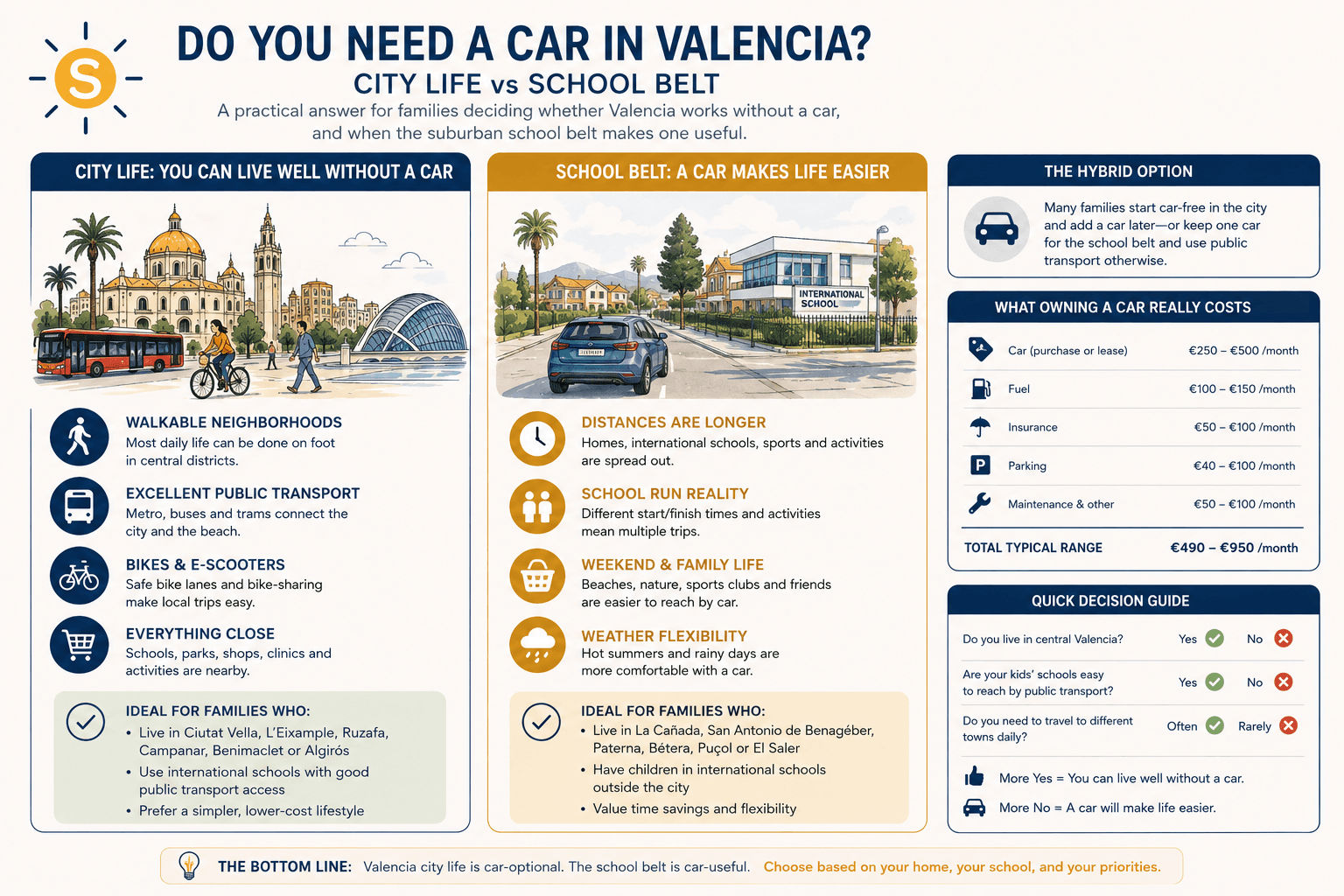
In central Valencia, many families can live comfortably without a car. In the suburban school belt, the answer changes quickly because school runs, groceries, and weekend logistics start to depend on driving.
Key takeaways
- Central Valencia can work without a car.
- The school belt makes car ownership more useful.
- Parking costs change the equation quickly.
- School transport can reduce the need to own a second vehicle.
Before you set a date
Is your landing date realistic?
Most families move to Valencia three months later than they planned, because they find out about the school calendar too late. Five questions, thirty seconds, and you will know whether your date works.
Run the Readiness CheckLast updated: June 2026
In central Valencia, many families can live comfortably without a car. In the suburban school belt, the answer changes quickly because school runs, groceries, and weekend logistics start to depend on driving.
City life without a car
EMT València and Metrovalencia make central life easy enough that many families do not need to own a car at all, especially if they live in neighbourhoods with good tram or bus coverage. A monthly integrated SUMA ticket starts at 35 euros on the current Metrovalencia fare page, which is a very different cost profile from owning and parking a car.
If you live near the centre, the beach, or the main urban neighbourhoods, the daily rhythm is often simpler without a car. You walk, bike, use public transport, or take the school bus if your school offers one. That is one reason so many families fall in love with the city first and only later think about whether they actually need a vehicle.
Where a car starts to help
The suburban school belt is where car ownership becomes more useful. Schools in Puçol, Rocafort, Bétera, and the western suburbs sit outside the walkable city core, and even when school transport exists, parents often want flexibility for sport, errands, and after-school life.
Several school fee pages make the choice obvious. BSV lists transport at 199 euros a month, Caxton lists Valencia city transport at 182 euros a month, and Shackleton lists a school bus at 183 euros roundtrip and 109 euros one way for the academic year plan. That tells you the family logistics are already partly car-shaped in those areas.
Parking and car friction
The hidden cost is parking. EMT parking pages show monthly car passes starting at 97 euros in the daytime laborable option and going up to 220 euros for 24-hour monthly access. That is before fuel, insurance, maintenance, and the rest. Once you put the numbers next to the convenience, the city case for not owning a car becomes much stronger.
This does not mean cars are bad in Valencia. It means they are a logistics decision, not an identity decision. If you live centrally, the answer may be no. If you live around a school cluster, the answer may be yes.
What families usually decide
- Central urban family: often one car or none.
- Beach or coastal family: often one car for flexibility.
- School-belt family: usually one car, sometimes two if both adults commute widely.
- Family with school bus and remote work: often less car dependence than they expected.
The best choice is usually the one that matches the school, not the one that sounds most convenient on paper. For where the school clusters sit, see our guide to where to live near international schools and our Valencia for expats pillar.
Our short answer
You do not need a car to live in Valencia if you stay central and choose your schools carefully. You probably do want one if you move into the suburban school belt. The right answer is not about status. It is about how much time you want to spend on the school run.
Read next
Start with the relevant pillar, then compare the supporting article links inside the cluster.
Questions
Frequently asked questions
Can a family live in Valencia city without a car?
Yes. Many central families do exactly that because EMT, Metrovalencia, walking, and cycling cover daily life well.
When does a car become useful?
When the school is in the suburban belt, especially in Puçol, Rocafort, Bétera, or the western school areas.
Is parking expensive?
City parking can be a real cost. EMT parking passes start at 97 euros a month in one of the current monthly options and go higher for 24-hour access.
Are school buses common?
Yes. Several major schools publish school transport options, and that is one of the reasons families can live centrally while sending children to suburban schools.
What should I decide first, car or school?
School first. The school location usually decides whether a car is optional or practical.
Sources
- Metrovalencia publishes integrated monthly SUMA fares from 35 euros in the current fare page. Metrovalencia - Our fares accessed 2026-06-03
- EMT parking publishes monthly car parking passes from 97 euros and higher options up to 220 euros. EMT Valencia - Aparcamientos accessed 2026-06-03
- BSV publishes optional transport at 199 euros a month. British School of Valencia - School Fees accessed 2026-06-03
- Caxton publishes Valencia city transport at 182 euros a month. Caxton College - Fees accessed 2026-06-03
- Shackleton publishes school bus pricing for the current fee year. Shackleton International School - Fees 25-26 accessed 2026-06-03
Before you set a date
Is your landing date realistic?
Most families move to Valencia three months later than they planned, because they find out about the school calendar too late. Five questions, thirty seconds, and you will know whether your date works.
Run the Readiness CheckSpainlander plans
Spainlander plans Valencia moves for international families, sequenced around the school decision. Founded by Khris Rueda after moving from Canada in 2022. Three plans, each for up to two children:
- The Shortlist, €989
In seven days you know which education route fits your children, which schools are worth an application, and which dates govern your arrival.
See what a Shortlist looks like - The Application, €2,450
Your school decision becomes applications that are prepared properly, submitted with you inside the window, and followed until there is an answer.
- The Landing, €6,900
We take responsibility for coordinating your school, housing, administrative and arrival workflow, so your first weeks run on a sequence instead of on your evenings.
Final price. Taxes included where they apply.